Just want to say that I am looking forward to seeing the presentations today. I know all of you have worked hard and I hope yesterday's critique session was helpful.
Don't forget that you have an extension on your papers until Thursday at 5pm.
I'm planning to celebrate the end of interim by going to see the mummies exhibit in Charlotte on Friday. What celebrations do you have planned? I hope you get to do something fun before the spring semester starts.
Wednesday, February 1, 2012

Wednesday, January 25, 2012
Going Off-Topic Today

I'm headed off topic today (and you feel free to do so as well, whenever your please!) because something I read with my morning coffee really got me to thinking. That doesn't happen very often, because my morning reading isn't normally very 'deep'!
But today I picked up the newest copy of Newsweek and read an article entitled "Ice Queens: They Save Their Eggs And Thrive At Work. Diane Sawyer's Secret To Resetting The Biological Clock." The gist of the story is that anchorwoman Diane Sawyer is encouraging the younger women who work for her to go to a fertility clinic in New York and have some of their eggs frozen, so that if they reach their forties without having had children (because of work pressures or because of not having met a potential father) they can still have a chance at having a child of their own. As we all know, biology plays a cruel trick on women. While men can sire kids up to Strom Thurmond age, the window for ladies generally only lasts (naturally) until the late 30s. And those years---the 30s in particular---are also the years in which a woman builds her career. If she is in a profession that requires years of post-graduate work (like the academy, law, or medicine), she often can not afford to take time off to be a mom in this decade.
Freezing eggs is not a new technology, but the doctor featured in the article has developed a different process with a much higher rate of success. It is expensive---$15,000 for a single cycle that freezes 10 to 20 eggs---but the article predicts that the cost will come down as more and more working women choose this option. The article virtually urges people to become missionaries of this new technique, getting the word out to younger working women that they do have a choice and even more control over their own fertility.
As I read the article a couple of things jumped out. One was this sentence about some of the women who come to this clinic are sent in by their parents--"I know you want to work, but I want grandkids someday." Excuse me, are we still living in the 1950s? I believe parents should be honored and respected, but I don't believe they should have any control over their adult child's fertility! Yuck. It's one thing for mom and dad to drop hints, another thing entirely for them to send you to the clinic. I suddenly had this image of parents handing their daughters appointment slips for egg freezing as graduation presents. So much for the car or a trip to Europe, Missy, we are going to make damn sure we get grandkids whether you really want to have kids or not.
But then, on a more serious note, I began to wonder how---if this process does become common---would it change things for American women. As my veterans of women's history class know, the pill certainly changed everything. Reliable birth control gave women control over more than just when or if they would have kids, it gave them greater control over their entire lives because it freed them from a biological game plan. Would this technology go even further? Imagine if this became as common in 20 years as the pill is now. What if the 'normal' age of motherhood got pushed back from mid 20s-30s to mid-40s, or even (gulp!) late 40s early 50s? Would this be a good thing?
 Well, in some ways, it could be a good thing. A woman would have time to build a career (same for daddy) and maybe by their 40s the couple could BOTH take time off to spend as intensive parents. With advances in health care, exercise, and nutrition, a couple in their 40s might feel like a couple in their 20s. Plus, with age comes (hopefully) wisdom and maturity. Plenty of people in this world have grown up with older parents and have benefitted from it.
But I also wonder if we aren't looking at this from only one side. How will kids fare if their parents are nearing retirement age as the kids graduate from high school? If you're the last of the litter, so to speak, your parents might need you to care for them rather than to go on to college---is that fair to the child? Most kids today have moms and dads who can be active with them; what if most kids in the future grow up with parents who were financially well off, but physically less able? Does having more money make up for tossing around a ball or playing together on the slide?
All of those, of course, are big questions that only time and technology would answer. But here's one we could be addressing right now: is having kids right for everybody?
Obviously, this is why this article hit home to me. I've never thought I wanted to have children. Even growing up, I never played with baby dolls (I went straight for Barbies and the soap operas that I could create around them). When I was in my 20s and 30s, the guys I knew and dated were definitely NOT the type of dudes any women would want to have children with. I was 45 years old before I met a man I truly fell in love with and could have ever envisioned having a child with. But 45 (well, 48 now) is waaaaaayyyyyyy too old to think about having a kid. Would my life have been better if this technology had existed back in my FSU days and I could be 'expecting' right now?
I don't think so, because I have always known I didn't want kids. It's just something I've understood about myself. And what I think we should be doing, as a society, is having more open and honest discussions about why/when/how we bring children into this world. Children are a blessing---please don't think I hate kids (though I will admit to being scared of them to a large degree---so germy!) ---and I have such admiration for great parents (like Jeremy!) who put so much love, time and effort into raising a child.
But what worries me and why that article set me off is that I think children are becoming a commodity. They're more and more of a status symbol, a trophy, a thing to check off the list. Got my college education (check), my great job (check), my fabulous house (check)...now on to my designer baby. Or, couples who aren't ready for kids get pressured into having kids, either from their parents or community factors. A friend of mine once told me that if a childless couple moved into their neighborhood they were 'shunned' by the rest of the neighbors, that they 'didn't want people like that' in their cul-de-sac.
Having a child is probably the most important decision a person ever makes (because, let's face it, in this day and age you don't have to have two people involved!). But if our world is advanced enough to put childbearing off until late middle age, why aren't we mature enough to recognize that for some people going without kids is the right decision? Why those without children judged as either pitiful or selfish or pariahs? Why can't we recognize and respect all the different paths in life, and that people with and without kids (or with and without partners, for that matter) have such a diversity of good things to offer?
Why is technology always ahead of honest, thoughtful talk about life's most important decisions?
Tuesday, January 24, 2012
Don't Blink
Nerdy confession---I love the British TV show Doctor Who. In its new incarnation (the show began the year I was born!), a species of villain is the Weeping Angels. Here's a fan-made video that gives you a quick primer on why these aliens are so badddddd!
So why is this on my blog? Because I keep thinking that maybe I could do something with the idea of stone figures. Not sure what that might be, but here are some creepy statues from my collection. Consider them if you dare...but don't blink!!!!


So why is this on my blog? Because I keep thinking that maybe I could do something with the idea of stone figures. Not sure what that might be, but here are some creepy statues from my collection. Consider them if you dare...but don't blink!!!!


Sunday, January 22, 2012
How To Make A Ghost
I was reading about the phantasmagoria---entertainments that were popular in the period of the French Revolution and also during the Victorian era. They were forerunners of the modern horror movie, as they used magic lanterns (a forerunner of the movie projector) to cast images of ghosts, devils, and fantastic creatures on screens, smoke, or even a supposedly bare stage.
While it's hard to find a magic lantern these days, I did find a Youtube video that explains the principle behind 'Pepper's Ghost,' a technique developed by these entertainers around 1860. It's pretty amazing. I apologize for the potty mouth on the one girl, but I can certainly understand why she says what she does!
If you've ever been in the Haunted Mansion at Disney World, this same technique is used, very effectively, in the scene where ghosts whirl in and out of a ballroom.
While it's hard to find a magic lantern these days, I did find a Youtube video that explains the principle behind 'Pepper's Ghost,' a technique developed by these entertainers around 1860. It's pretty amazing. I apologize for the potty mouth on the one girl, but I can certainly understand why she says what she does!
If you've ever been in the Haunted Mansion at Disney World, this same technique is used, very effectively, in the scene where ghosts whirl in and out of a ballroom.
Saturday, January 21, 2012
What's Your Ghost Story?

 |
The pictures in this entry are all from Charleston (some of you may have recognized the location!). Charleston is one of the few places in the South where one can see elaborate 18th century tombstones. These masters and mistresses of plantations, or lords or merchant companies, wanted portraits in stone.

We were in Charleston during Spring Break of 2010. Now, I've never had a truly frightening experience in a cemetery, but when I leaned down to make the picture of the tombstone above (with the lady) it look like the eyes were moving. I jerked back and the eyes seemed to close. I nearly ran screaming in terror! My scientifically-inclined companion quickly pointed out that my perception was caused by the way the light shifted. But, you know, I kinda liked my explanation better. I liked imagining that a saucy Charlestonian ghost was flirting with me.
So here's a question for you folks---have you ever had a scary experience in a cemetery? Or have you ever seen (or heard, or smelled) a ghost? Have you seen the 'Eyes of Old Main' or met Ben Wofford late at night? I love collecting these stories. They are part of what makes us human---every culture has some type of belief about ghosts and spirits, so 'seeing a ghost' must occur all over the planet. These stories also help inspire me as I think about what kind of ghost encounter might occur in my next novel.
Who knows, your story might find a way into fiction, so don't be shy!!!!
Friday, January 20, 2012
Cheating A Bit Today
Rather than post about research, today I'm linking to one of my other blogs, the one I keep to help promote my Sherlockian work. In case you haven't heard, CBS is considering doing its own version of the BBC series SHERLOCK (which takes the stories and puts them in the modern world). If you haven't seen it yet, you should!!! It is amazing in all sorts of ways.
I'm making an argument that the only way for CBS to pull this off is not to copy, but to push the envelope further. Gee, I wish CBS would call me in to help them---I have all sorts of ideas!---but I suspect the Fall will find me teaching western civ, not serving as a creative consultant....
http://woffproff.typepad.com/blog/2012/01/thoughts-on-a-cbs-sherlock.html
I'm making an argument that the only way for CBS to pull this off is not to copy, but to push the envelope further. Gee, I wish CBS would call me in to help them---I have all sorts of ideas!---but I suspect the Fall will find me teaching western civ, not serving as a creative consultant....
http://woffproff.typepad.com/blog/2012/01/thoughts-on-a-cbs-sherlock.html
Thursday, January 19, 2012
Monsters and Musings

While reading through The Element Encyclopedia of Ghosts & Hauntings, I came across the story of the "Monster of Glamis." I think it has some potential for further fiction.
Glamis Castle is--as you can tell by the picture--a magnificent dwelling in Scotland. Built in the 14th century, it became the home of the Lyon family, whose eldest males held the title of Earl of Strathmore. In 1821, the birth of another heir was expected. The child, named Thomas Bowles-Lyon, supposedly was born and died on the same day, not an uncommon occurrence even among the nobility. But some discrepancies in the matter (like the child's lack of a tombstone, and the fact that a second child was given the same name) helped give rise to a darker tale.
According to this story, the infant was so hideously deformed that even his own parents could not bear to look at him. It was said the child had an egg-shaped body with no
 neck, and tiny, malformed arms and legs. Unable to love his son but also unwilling to kill him, the Earl had the infant placed in a secret room and assigned one servant to tend to him. It was assumed the boy would not live long, but to everyone's surprise, he flourished.
Of course, such a monstrosity could not be allowed to inherit a title. But should his presence ever become known, the scandal would destroy the family. Thus the 'monster' became the 'family secret.' He lived for over a century, and each heir was shown the monster on his 21st birthday. Taking care of the creature became the special charge of the current Earl, even though the sight of the monster was supposedly enough to 'drive a man to madness.'
I have to admit that when I read this story, my first reaction was real sympathy for the 'monster'! It wasn't his fault that he was born that way. Then I began to wonder what kind of a person he would have become. How lonely would he have been? Might he have crept around the castle, spying on his 'normal' family? And what if his mind was as sharp as his body was deformed?
 Reading further, I discovered that Glamis is considered one of the most 'haunted' castles in the UK. Supposedly the monster kept company with Janet Douglas, wife of the sixth Lord of Glamis, who was burned at the stake for witchcraft and supposedly appears enveloped in flame. Another resident ghoulie is Earl Beardie, condemned to wander through the castle for the crime of gambling away his soul to the Devil. Add to this the shades of a madman, a woman without a tongue, several 'grey ladies,' and a vampire girl, and you have quite the creepy menagerie.
But if you were a monster, would ghosts really scare you? Or would they become your friends? And how would you feel if they were suddenly gone?
I do have a point here---so many of the great stories from Britain involve haunted houses and restless spirits. But what if someone could 'steal' them away? And what if the only people who missed them were fellow outcasts, the monsters of society? And what if this Monster of Glamis, because he is rich and a rightful Earl, could call in Sherlock Holmes to solve the mystery of his vanished companions?
OK...maybe I have another idea I can play with.
Wednesday, January 18, 2012
The Strangest Historical Sources Ever...

I'm always reminding students that primary sources are not just newspapers, documents, and diaries. Material culture (pots and pans, clothing,furniture, etc.) is a vital primary source. Painted portraits are also a wonderful primary source because not only do they hint at how a person may have looked, they scream at how he/she wanted to be remembered.
So for today's venture into "weird stuff that only Dr. Revels would research,' let's consider the Victorian practice of post-mortem photography or memorial portraiture.
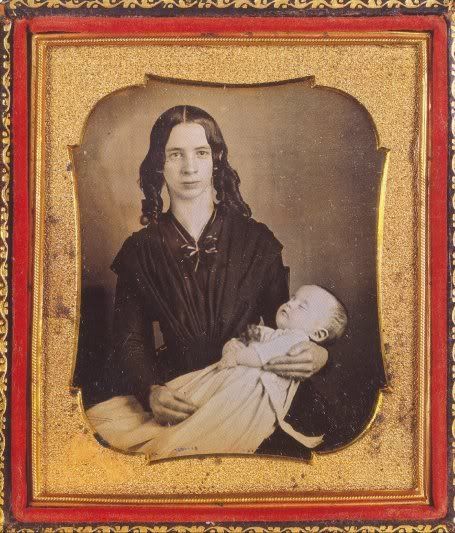
With the invention of the daguerreotype in 1839, people of moderate means now had an alternative to the pricey painted portrait. A perfect likeness could be preserved for all time. But early forms of photography were still costly, and there was no such thing as a 'quick snapshot.' Most people would have their picture taken only a few times during their lifetime, and for some, the likeness was captured only after death.
Child mortality rates were astronomical in the 19th century. For many grieving parents, taking a photograph of the dead child was a way to keep the child's memory alive. The image, like the one above, provided great comfort. A quick web search will turn up hundreds of daguerreotypes like this. An older child might be photographed on a sofa, surrounded by favorite toys. I've seen pictures where the deceased child was propped in a chair and dutifully surrounded by his surviving siblings.
Sometimes photographers went to rather ghoulish lengths to make their subjects appear more lifelike, instead of settling for the idea that the departed was peacefully sleeping. The subject was sometimes propped up, with 'open eyes' painted on the closed eyelids.
By the end of the 19th century, photographers no longer attempted to fool the viewer. Instead, portraits were made of the dead resting in their caskets, often surrounded by massive floral arrangements or religious artifacts. Considering the Victorian love of showing off possessions, and its protracted cult of mourning, this final 'display' made perfect sense.
The practice of post-mortem photography began to wane in the early 1900s. Brownie cameras had made amateur photography popular, and families had many pictures of loved ones in healthier days to choose from.
However, some families still choose to continue this form of remembrance. A number of photographers offer their services free of charge to families who lose infants at birth; for some parents there is the sense that having a photograph of the child makes him/her a part of the family forever.
So what can we learn from these pictures? Well, I think they certainly give us insight into what was considered a proper and respectable way to remember loved ones. I think they hint also that death was much more a part of everyday life; what I mean is that people died at home, children perished at a frightful rate, and death was not something that people tried to pretend didn't happen. While this picture-taking custom may seem morbid to us, I suspect that the Victorians would think we were the ones with the 'problem,' sweeping death under the rug and living our lives as if we were immortal! And, as a social historian I have to point out that these pictures tell us a lot about the ordinary parts of life---how people dressed, how they wore their hair, and what they considered worth remembering.
I won't put any more pictures here, but if you're curious, there are plenty of these on the internet, along with speculation that there made have been more of these memorials than any other kind of photograph in the late 19th century. I'm no so sure about that claim, but they certainly are a somewhat chilling look into a time very different to our own.
Meeting Changed! Please Read Your E-Mail!
Interim students---please check your email for an important message from me! We'll meet on Thursday, not Wednesday, for individual 'progress report' sessions.
It would also be helpful if, for the meeting, you could jot down which sources you feel you have worked with a lot already, and which you are still 'getting to' over the course of the next week.
Tuesday, January 17, 2012
Resurrection Men
 More to fill undo 'weird things Dr. Revels researches,' I guess!
Because I want to play with the idea of a necromancer in my next novel, I decided to look back on the famous 'resurrection men' of late 18th and early 19th century. After all, if my bad guy is going to be calling up the dead, he needs some dead to 'practice' on. Maybe this is how he acquires his corpses.
Resurrection men were grave robbers. In this period, it was very hard for doctors and medical schools (many of which were private and just offered courses in anatomy) to find bodies to dissect. Today, we take it for granted that physicians study the human body and that many people choose to donate their bodies to science. But before the modern era, most people had a horror of dissection and religious objections to the practice. Therefore doctors and educators often were forced to stoop to dubious means of getting subjects for study. Ghoulish types learned that medical professors did not ask questions, and the 'fresher' a body was, the more money the doctor might pay for it. (Keep in mind that very few bodies were embalmed in this time and most funerals took place only a day or so after death, for very obvious reasons!)
It might astonish you to learn that it was not a felony to steal a body! However, if the grave robber was caught with any clothing or jewelry the body might have worn, that was a very serious crime. Not surprisingly, the resurrection men became quite skilled at digging down to the head of a coffin, breaking it open, and pulling the corpse out with a rope. They pitched the shroud back into the coffin and tossed the naked body into a sack. Then they hurried to the back door of an office or medical school and collected their cash.
 Some of these ghouls were organized into gangs, and had a variety of tricks for scooping out the best (i.e. 'freshest') corpses. Often, they would employ a female accomplice to go to a funeral to note the exact spot of burial and whether any precautions were being taken. These people would also watch the poorhouses, and show up to claim any recent, friendless deceased.
Though most victims of the resurrection men were probably poor, the fear of having one's parent, spouse, or child resting on a dissecting table, rather than in peace, was a common fear among the middle class. A family might employ some friends to stand watch at the cemetery for a couple of nights after the burial; it was presumed that within a few days a corpse would not be worth digging up. Other families had iron cages placed atop graves as a deterrent.
Two of the most famous resurrection men, William Burke and William Hare, figured out that the best way to get a fresh body was not to wait for nature to take its course---so they started killing poor people, mainly residents of their boarding house, instead!
The Anatomy Act of 1832 helped bring an end to this practice, as it allowed for private donations of bodies and made corpses of deceased, unclaimed indigents available to medical schools. Doctors no longer had to pay for their most essential supply.
But there's one problem---my story will take place in 1897. That's more than 60 years after the act was passed. So will the idea that one character is suspected of this practice really ring true?
Guess I'll have to dig deeper....
Monday, January 16, 2012
Apology To My Interim
I'm sorry I'm behind on reading and commenting on the blogs (not to mention reporting on research). My mother came up for a weekend visit, and in the process I got sick (bad cold, NOT sick of spending time with my mom!). I hope to be feeling better tomorrow and will do my best to get caught up on everything.
Friday, January 13, 2012
We Are Dangerous People
Thanks for the comments everyone!
Something Alex wrote gave me a quick idea that I wanted to express before going on with the morning's research. He mentioned people being afraid of art in the early modern world (iconoclasm) and of books in general. Today we'd say anyone who was 'scared' of art or books was being pretty silly.
Or would we?
I think one of the biggest problems this country faces is anti-intellectualism. The vast majority of people in this nation don't trust 'smart people.' I joke in class about saying the wicked 'i' word, but every time I make that joke I can tell people think it isn't funny at all.
Back in 1990, when I first arrived at Wofford, I was really eager to fit into the Spartanburg community and find new friends. I heard about a 'singles' Bible study at a local church and decided to check it out. (Yes, despite the topic I work on, I do consider myself Christian, though these days I really can't figure out what denomination I am, if any!) There were about 6-7 people at the meeting, and we went around the circle introducing ourselves, everyone saying what he or she did for a living. I told them I was a history professor at Wofford.
Conversation stopped. People physically drew back in their chairs, away from me. I have rarely felt more uncomfortable than I was in that hour. Later, when I told people about this experience, they said 'you should have just said you were a teacher, not a professor. They were intimidated because they thought you were an intellectual."
Then I got furious! I worked HARD to be called professor! There's nothing wrong with being a 'teacher', but that is not my title. (And for the record, a teacher is an intellectual as well, but my title means something to me because it was what I wanted to obtain in life!) I certainly didn't correct anyone's English or dates; I hadn't done anything other than said where I worked. Why should I have to hide the fact of what I did, or take criticism for the way other people reacted to me?
Ever since that incident, I've been more aware of how people respond to 'intellectuals.' And I think we need to reclaim this word. Being an 'intellectual' doesn't mean you are an asshole. It doesn't mean you look down on others, or despise people who don't have college or even high school educations. It doesn't mean you are a rocket scientist (unless you are!) or a social critic. It simply means you love to learn, that you value your education, and that (hopefully) you have the tools of critical analysis at your fingertips. An intellectual doesn't accept the world in 30 second sound bites; the intellectual wants the whole picture, with both sides of the story. And guess what, an intellectual does RESEARCH.
So all of you are intellectuals, whether you knew it or not! (We should get t-shirts....)
OWN the word, lovely people. Take it back! Be proud of what you're doing this interim and tell other people about it. (And try to stress something other than 'I can sleep as late as I want to,' OK?)
Wednesday, January 11, 2012
More Bad Boys and Books
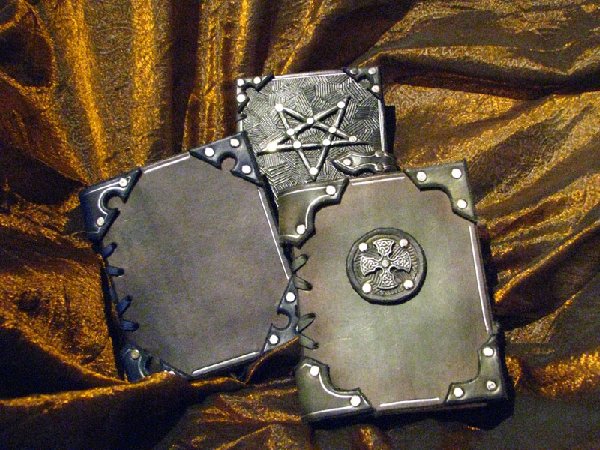
I spent part of last night and this morning reading more from Forbidden Rites. In the process, I'm learning more about necromancers and their books, and I'm also beginning to rethink my original plot for my novel.
As stated yesterday, the original concept of a necromancer is one who raises spirits and/or the dead. But by the 1400s, the term was being used to also encompass anyone who works demonic magic, summoning dark forces to do one's dirty work. It also became a term applied strictly to well-educated men who practiced the dark arts. A number of necromancers were clerics! I guess that's one thing that has really surprised me, how thin the line between orthodoxy and heresy was in the medieval world. A necromancer had to be well-educated, because the spells he worked were written in Latin, or some corruption of it, and in this period it was generally only churchmen who had such an education. Also, to command demons a necromancer had to be calm, logical, and possess an iron will. These were qualities that people in the late middle ages did not ascribe to women!
Another intriguing aspect that I gathered from the reading is that spellbooks were considered dangerous entities, and not only for the 'recipes for evil' that they contained. Many church officials believed that the books were literally filled with demons, and that a necromancer might hear calls from these evil servants who were confined within the book's pages. (Naturally, I have a lot of fun imagining what these books might say! I keep hearing Darth Vader's voice---'what is thy bidding, my master'?) One fifteenth-century bishop grabbed a book and hurled it into the fire; the thickness of the black smoke its burning produced convinced him that the demons were being eradicated along with the pages.
As I learn more about the books, I'm beginning to think that it might be worth changing my plot around a bit. I had based my first (and still rather unformed) plot on the idea that a necromancer is trying to conjure up a particular villain from the Sherlockian canon. but what if he's after a dangerous book instead? Maybe one belonging to a certain legendary necromancer? Hhmmm...this bears investigating!
Tuesday, January 10, 2012
Necromancy and Dangerous Books

This past weekend was fairly unproductive. My Sherlockian scion had its annual gala (a party where we celebrate Sherlock Holmes' birthday) so I spent most of Saturday getting ready for it. Saturday was also the last day that Dr. Moeller was in town; I don't guess its a secret to any of you that he's my 'sweetie'. He left for Africa on Sunday, so I'll admit that it took me some time to get back in the mood to do research of any variety. But now that I know he and his students have arrived safely, maybe I can get 'focused' the way I should be.
Today I tried to focus on coming up with a better understanding of necromancy, since I have been thinking that I want the villain of my next novel to be a necromancer. I had assumed the word meant someone who can raise the dead to do his/her bidding. In the Anita Blake novels the heroine begins as a necromancer who raises the dead for relatives who have some kind of final question to put to them, such as 'Uncle Ted, where did you hide the loot from that bank robbery you pulled off ten years ago?'
What I learned is that while a necromancer is someone who raises the dead, the more classical idea of why he brings them back is for purposes of divination---to learn about the future, not the past. In some versions, the dead are only useful for a year after death; past that point, don't bother with asking about the winner of next year's World Series. That's fascinating to me. Why the time limit? Did it have something to do with people's observations of how bodies decay, that they presumed even a powerful wizard couldn't learn anything once a body was reduced to bone? (OK, enough with the gross speculation.)
Probably the most famous necromancer from literature is the witch of Endor, and no, she's not from the Star Wars movies! She's from the Bible, and she conjures up the spirit of the prophet Samuel for King Saul. (And this event is the subject of the picture at the top of this post---I can't figure out how to get the picture where I want it!) I had to go back and refresh my memory of this story. Basically, Saul is looking for some help in how to handle his enemies, but Samuel is none too happy about being awoken, chews the king out for disobeying God, and predicts his defeat and death, all of which quickly come to pass. Sounds to me like asking the dead for advice can lead to serious unpleasant consequences.
I also checked out a book called Forbidden Rites: A Necromancer's Manual. The introduction to the states that owning a book of magical spells was almost as dangerous in the 1300-1400s as actually trying them out. Having such a tome in one's possession was seen as pretty damning evidence that a person was a witch or wizard. It listed a number of conjurers who were arrested and/or burned, and their books tossed into the flames as well. Just think how much we take our freedom to read ANYTHING for granted.
More to report tomorrow, I promise. Since it's supposed to be an absolutely nasty day, I brought a lot of work home with me.
Friday, January 6, 2012
Happy Sherlock Holmes' Birthday!

Sherlock Holmes was born this day in 1854---at least that's what we think. Like many things in the Sherlockian 'canon' (the 56 stories and 4 novels written by Arthur Conan Doyle) this date was never clearly stated. Instead, readers 'deduced' it through 'clues' within the text---Alex and Hannah, are you paying attention?! As English majors, you should really like this! The clues are that Holmes often quoted Shakespeare, but there was only only play that he quoted twice: Twelfth Night. Could it have been his favorite because 'twelfth night' is January 6, his birthday? Also, we know that one of Holmes' cases began on January 7, and on that morning Holmes was exhibiting all the classic symptoms of a hangover! Could he have been out the night before, celebrating his birthday?
OK, so maybe that seems far-fetched, but that's the kind of fun we have when we play 'the game,' which is what we call it when we make leaps of logic from bits and pieces of the Sherlock Holmes stories.
My game today was to try and find more information on the Palermo catacombs. So far, I haven't had a lot of luck. There are many references to it on the internet, but already I've found a lot of conflicting information. Just because it's on the internet doesn't mean it's true!!!! But I have found another helpful source: Dr. Peter Schmuck of the Art History Department. He has visited the catacombs and has postcards. I'm looking forward to talking to him because the things I want to know (Are these rooms very small or large? Do they smell? Are they cold?) are things that someone who has been there can tell me, but I wouldn't necessarily learn from articles and photographs.
There's a tip for research---always remember what a rich sources professors can be! Even professors consult professors, so don't hesitate to ask questions.
Thursday, January 5, 2012
Interim REALLY Begins
Tonight was the first formal interim meeting. I know it sounds geeky and smarmy and all that, but I really ENJOY getting to sit with students and hear about their projects. I'm completely blown away by the things that are being studied and the ambitions that these young people have. Every time something goes wrong in my life, I flirt with the idea of changing careers, of wondering if I could make it on writing or editing alone. But the reality is I would really suffer if I didn't get to be in the company of college students on a regular basis.
Speaking of suffering, I was very frustrated with my inability to find books, either in our library or on PASCAL, about the Palermo catacombs. There is a book of photographs that I am itching to get my hands on, but I guess I will have to order it through inter-library loan. I worry what Ms. Cathey must think of me when she processes my orders! All last semester is was H. P. Lovecraft biographies, and now The Living Dead: Inside the Palermo Crypt.
Wednesday, January 4, 2012
What We'll Do Tomorrow
The research interim students (both in Humanities and Sciences) are meeting in the Holcombe Room at 4pm. We'll discuss everyone's project, have dinner, and listen to a presentation on effective presentations.
Looking forward to seeing everyone there!
Subscribe to:
Comments (Atom)