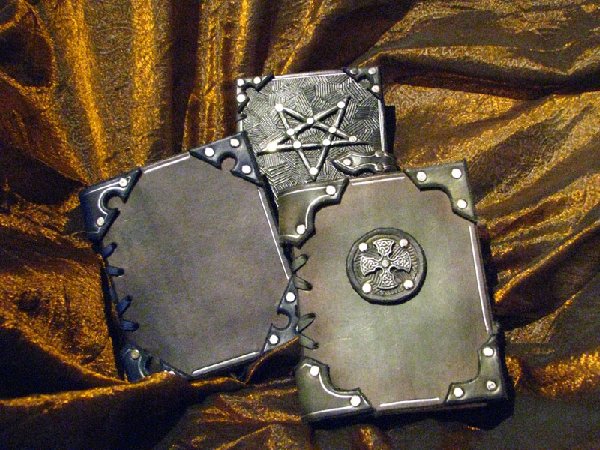
I spent part of last night and this morning reading more from Forbidden Rites. In the process, I'm learning more about necromancers and their books, and I'm also beginning to rethink my original plot for my novel.
As stated yesterday, the original concept of a necromancer is one who raises spirits and/or the dead. But by the 1400s, the term was being used to also encompass anyone who works demonic magic, summoning dark forces to do one's dirty work. It also became a term applied strictly to well-educated men who practiced the dark arts. A number of necromancers were clerics! I guess that's one thing that has really surprised me, how thin the line between orthodoxy and heresy was in the medieval world. A necromancer had to be well-educated, because the spells he worked were written in Latin, or some corruption of it, and in this period it was generally only churchmen who had such an education. Also, to command demons a necromancer had to be calm, logical, and possess an iron will. These were qualities that people in the late middle ages did not ascribe to women!
Another intriguing aspect that I gathered from the reading is that spellbooks were considered dangerous entities, and not only for the 'recipes for evil' that they contained. Many church officials believed that the books were literally filled with demons, and that a necromancer might hear calls from these evil servants who were confined within the book's pages. (Naturally, I have a lot of fun imagining what these books might say! I keep hearing Darth Vader's voice---'what is thy bidding, my master'?) One fifteenth-century bishop grabbed a book and hurled it into the fire; the thickness of the black smoke its burning produced convinced him that the demons were being eradicated along with the pages.
As I learn more about the books, I'm beginning to think that it might be worth changing my plot around a bit. I had based my first (and still rather unformed) plot on the idea that a necromancer is trying to conjure up a particular villain from the Sherlockian canon. but what if he's after a dangerous book instead? Maybe one belonging to a certain legendary necromancer? Hhmmm...this bears investigating!

The gender and class dynamics to necromancy seem so interesting! Who would have known? Thanks for sharing!
ReplyDeleteThis also seems related to fear about art going on in the early modern age. This fear can be seen most strongly in the iconoclasm, but people were also wary of books. Imagine how much more frightening a book that purports to have visible magical powers must have been!
Happy researching!
This reminded me of a book I read over break called "A Discovery of Witches" by Deborah Harkness. It's not really about necromancy, but the main character is a science historian who is interested in alchemy. There are also vampires, and daemons, and an enchanted alchemy book that everyone is after - and that could be really dangerous if it got into the wrong hands.
ReplyDelete