
I'm always reminding students that primary sources are not just newspapers, documents, and diaries. Material culture (pots and pans, clothing,furniture, etc.) is a vital primary source. Painted portraits are also a wonderful primary source because not only do they hint at how a person may have looked, they scream at how he/she wanted to be remembered.
So for today's venture into "weird stuff that only Dr. Revels would research,' let's consider the Victorian practice of post-mortem photography or memorial portraiture.
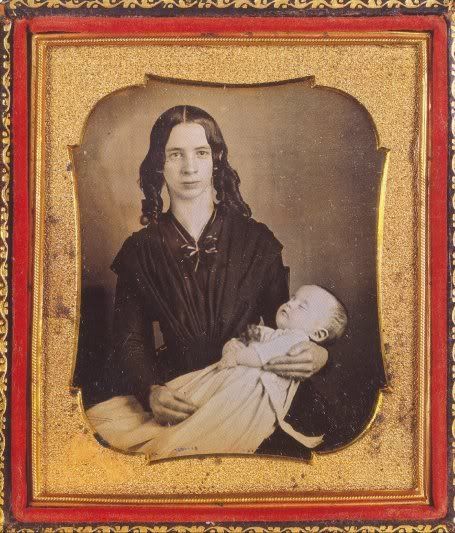
With the invention of the daguerreotype in 1839, people of moderate means now had an alternative to the pricey painted portrait. A perfect likeness could be preserved for all time. But early forms of photography were still costly, and there was no such thing as a 'quick snapshot.' Most people would have their picture taken only a few times during their lifetime, and for some, the likeness was captured only after death.
Child mortality rates were astronomical in the 19th century. For many grieving parents, taking a photograph of the dead child was a way to keep the child's memory alive. The image, like the one above, provided great comfort. A quick web search will turn up hundreds of daguerreotypes like this. An older child might be photographed on a sofa, surrounded by favorite toys. I've seen pictures where the deceased child was propped in a chair and dutifully surrounded by his surviving siblings.
Sometimes photographers went to rather ghoulish lengths to make their subjects appear more lifelike, instead of settling for the idea that the departed was peacefully sleeping. The subject was sometimes propped up, with 'open eyes' painted on the closed eyelids.
By the end of the 19th century, photographers no longer attempted to fool the viewer. Instead, portraits were made of the dead resting in their caskets, often surrounded by massive floral arrangements or religious artifacts. Considering the Victorian love of showing off possessions, and its protracted cult of mourning, this final 'display' made perfect sense.
The practice of post-mortem photography began to wane in the early 1900s. Brownie cameras had made amateur photography popular, and families had many pictures of loved ones in healthier days to choose from.
However, some families still choose to continue this form of remembrance. A number of photographers offer their services free of charge to families who lose infants at birth; for some parents there is the sense that having a photograph of the child makes him/her a part of the family forever.
So what can we learn from these pictures? Well, I think they certainly give us insight into what was considered a proper and respectable way to remember loved ones. I think they hint also that death was much more a part of everyday life; what I mean is that people died at home, children perished at a frightful rate, and death was not something that people tried to pretend didn't happen. While this picture-taking custom may seem morbid to us, I suspect that the Victorians would think we were the ones with the 'problem,' sweeping death under the rug and living our lives as if we were immortal! And, as a social historian I have to point out that these pictures tell us a lot about the ordinary parts of life---how people dressed, how they wore their hair, and what they considered worth remembering.
I won't put any more pictures here, but if you're curious, there are plenty of these on the internet, along with speculation that there made have been more of these memorials than any other kind of photograph in the late 19th century. I'm no so sure about that claim, but they certainly are a somewhat chilling look into a time very different to our own.

I love material culture used as a primary source! I feel like it helps make such a strong argument, and it can be easier to riffle through photos instead of pouring over a book. McClintock's *Imperial Leather* uses a lot of visual analysis of ads and photographs to examine Victorian ideas on race and empire. I'm pretty sure Susan Sontag also writes extensively about photography, but I haven't read her version.
ReplyDeleteYour foray into the nitty-gritty of Victorian life really makes the culture come alive. Kudos!